
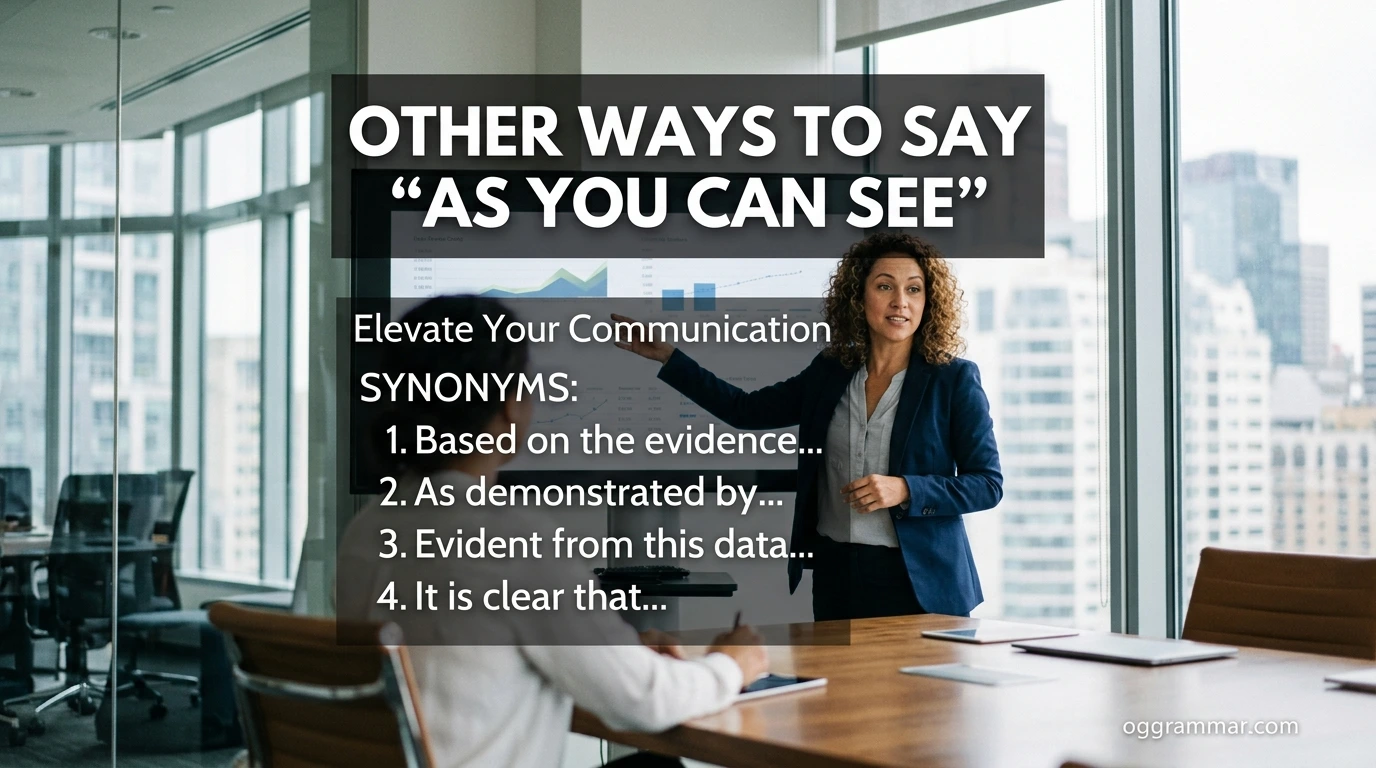
A good transition phrase can do more than move a sentence forward. It can shape how clearly your idea lands.
“As you can see” is a familiar phrase because it works. It guides the reader, points to evidence, and signals that something is about to be obvious. Still, people search for other ways to say it because they want their writing to sound fresher, more polished, or more natural in different settings. In essays, reports, presentations, and even everyday explanations, the right transition can make your ideas feel sharper and more professional.
That is where communication skills matter. An articulate speaker knows that even a small phrase can affect the rhythm of a paragraph. An expressive communicator understands that the same idea can sound formal, casual, confident, or persuasive depending on the wording. Whether you are refining eloquent writing, verbal intelligence, storytelling skills, or communication mastery, learning alternatives to “as you can see” gives you more flexibility and style.
People who are good with words often notice this instinctively. They know that language is not just about meaning. It is about timing, tone, and relationship. A thoughtful transition can help the reader follow your logic without feeling pushed.
In this guide, you will find the best other ways to say “as you can see,” along with meanings, tones, best-use cases, example sentences, detailed explanations, emotional or professional impact, and real-life usage context. You will also learn how to choose the right phrase based on the situation, what to avoid in professional settings, and how subtle wording changes can make your communication feel more natural and memorable.
Why wording matters when you guide attention
A transition phrase is never just a transition phrase. It is part of the argument.
A persuasive communicator understands that the words you choose can make the reader feel:
- guided
- informed
- respected
- engaged
- confident in your point
- interested in what comes next
That matters because “as you can see” can sometimes sound too obvious or even a little condescending if overused. In the right context, it is clear. In the wrong context, it can feel repetitive or forceful. A better alternative helps you match the tone of the writing instead of sounding mechanical.
Communication mastery is not only about being clear. It is about being clear in a way that fits the moment.
What “good with words” means here
Being good with words does not mean sounding overly fancy. It means choosing the phrase that fits the audience, the setting, and the point you want to make. An expressive communicator knows when to be formal, when to be direct, and when to keep things simple.
Did you know?
Readers often respond better to transitions that feel natural and varied. Even when the evidence is strong, repetitive phrasing can make writing feel less polished than it really is.
Quick comparison table of alternatives
| Alternative Phrase | Tone | Meaning | Best Use Case |
| As shown above | Clear, direct | Refers to something already presented | essays, reports, presentations |
| As illustrated | Polished, explanatory | Uses an example or visual to clarify | academic writing, formal explanations |
| As demonstrated | Formal, strong | Evidence has already proved the point | reports, analysis, argument writing |
| As evidenced by | Academic, precise | Points to proof or supporting data | research, essays, business reports |
| Clearly | Direct, confident | Signals that the point is obvious | speeches, essays, persuasive writing |
| It is evident that | Formal, structured | States that something is plainly true | academic and professional writing |
| This indicates that | Analytical, neutral | Shows what the evidence suggests | research, data analysis |
| This shows that | Simple, versatile | Explains what the information means | essays, reports, everyday writing |
| From this, it is clear that | Formal, logical | Draws a conclusion from prior information | essays, presentations |
| Therefore | Formal, concise | Introduces a conclusion or result | academic writing, arguments |
| This makes it clear that | Clear, explanatory | Emphasizes that the point is obvious | reports, analysis |
| As reflected in | Polished, reflective | Refers to something that mirrors a larger point | essays, professional writing |
| The evidence suggests | Measured, academic | Points to a likely conclusion | research, formal analysis |
| In short | Simple, conversational | Summarizes the point briefly | speeches, casual writing |
| To put it simply | Friendly, explanatory | Restates something in easier language | presentations, teaching, informal writing |
Best other ways to say “As You Can See”
As Shown Above
Meaning
You are directing attention to something already presented.
Tone
Clear, direct, and neutral.
Best Use Case
Reports, essays, presentations, data explanations.
Example Sentence
“As shown above, the numbers increased steadily over the last quarter.”
Detailed Explanation
This is one of the cleanest alternatives because it is simple and accurate. It works best when you have already presented a chart, example, or paragraph that supports your point.
Emotional or Professional Impact
It feels organized, grounded, and easy to follow.
Real-Life Context
Used in academic writing, business reports, and slides.
As Illustrated
Meaning
You are showing that an example or visual helps explain the point.
Tone
Polished, academic, and explanatory.
Best Use Case
Essays, lectures, formal writing, visual explanations.
Example Sentence
“As illustrated in the case study, the strategy improved customer satisfaction.”
Detailed Explanation
This phrase sounds a bit more elegant than “as you can see.” It works especially well when the idea has been made clear through an example, diagram, or illustration.
Emotional or Professional Impact
It feels thoughtful and well-structured.
Real-Life Context
Used in academic essays, presentations, and analysis.
As Demonstrated
Meaning
You are saying the evidence has already proved the point.
Tone
Formal, strong, and confident.
Best Use Case
Research writing, reports, persuasive essays.
Example Sentence
“As demonstrated by the results, the method is highly effective.”
Detailed Explanation
This phrase works well when you want to sound certain and evidence-based. It is especially useful in writing where proof matters.
Emotional or Professional Impact
It feels credible and authoritative.
Real-Life Context
Used in research papers, reports, and professional writing.
As Evidenced By
Meaning
You are pointing to proof that supports your claim.
Tone
Academic, precise, and formal.
Best Use Case
Research, scholarly writing, business analysis.
Example Sentence
“As evidenced by the survey results, customer satisfaction has improved.”
Detailed Explanation
This phrase is slightly more formal and analytical than “as shown above.” It is ideal when you want to emphasize proof in a measured way.
Emotional or Professional Impact
It feels rigorous and credible.
Real-Life Context
Used in essays, papers, and data-driven reports.
Clearly
Meaning
You are signaling that the point is obvious or easy to understand.
Tone
Direct, confident, and simple.
Best Use Case
Speeches, persuasive writing, everyday explanations.
Example Sentence
“Clearly, the new policy has made a positive impact.”
Detailed Explanation
This phrase is short and powerful, but it can feel too forceful if used too often. It is best when the evidence is strong and the audience is likely to agree.
Emotional or Professional Impact
It feels assertive and decisive.
Real-Life Context
Used in essays, presentations, and spoken explanations.
It Is Evident That
Meaning
You are saying something is plainly visible or obvious from the information.
Tone
Formal, structured, and academic.
Best Use Case
Formal essays, analysis, reports.
Example Sentence
“It is evident that the team benefited from the new approach.”
Detailed Explanation
This phrase sounds polished and professional. It works well when you want to sound objective and clear without sounding casual.
Emotional or Professional Impact
It feels serious and intelligent.
Real-Life Context
Used in academic writing, formal reports, and structured arguments.
This Indicates That
Meaning
You are explaining what the information suggests.
Tone
Neutral, analytical, and professional.
Best Use Case
Data analysis, research, business writing.
Example Sentence
“This indicates that the campaign resonated with the target audience.”
Detailed Explanation
This phrase is especially useful when you want to avoid sounding too absolute. It suggests a conclusion without overstating it, which makes it ideal for analytical writing.
Emotional or Professional Impact
It feels careful and logical.
Real-Life Context
Used in reports, research summaries, and presentations.
This Shows That
Meaning
You are explaining the meaning of the information in a straightforward way.
Tone
Simple, versatile, and natural.
Best Use Case
Essays, reports, presentations, teaching.
Example Sentence
“This shows that consistency plays a major role in success.”
Detailed Explanation
This is one of the most flexible alternatives because it is clear and easy to understand. It works in both formal and semi-formal writing.
Emotional or Professional Impact
It feels approachable and direct.
Real-Life Context
Used in papers, teaching materials, and spoken explanations.
From This, It Is Clear That
Meaning
You are drawing a conclusion from the evidence or explanation.
Tone
Formal, logical, and polished.
Best Use Case
Essays, research, presentations, arguments.
Example Sentence
“From this, it is clear that communication skills are central to team success.”
Detailed Explanation
This phrase is useful when you want your writing to sound methodical. It makes the link between the evidence and the conclusion very explicit.
Emotional or Professional Impact
It feels organized and persuasive.
Real-Life Context
Used in analytical writing and formal presentations.
Therefore
Meaning
You are introducing a logical conclusion or result.
Tone
Concise, formal, and strong.
Best Use Case
Academic writing, argumentation, conclusions.
Example Sentence
“The sample size was small; therefore, the results should be interpreted carefully.”
Detailed Explanation
This is one of the most classic transition words in formal writing. It is especially effective when you want to show a direct logical connection between two ideas.
Emotional or Professional Impact
It feels controlled and precise.
Real-Life Context
Used in essays, reports, and formal reasoning.
This Makes It Clear That
Meaning
You are emphasizing that the point is obvious from the information.
Tone
Clear, explanatory, and confident.
Best Use Case
Reports, instructions, analysis, presentations.
Example Sentence
“This makes it clear that additional training may be needed.”
Detailed Explanation
This phrase works well when you want to sound direct but not overly blunt. It is useful in professional writing where clarity matters.
Emotional or Professional Impact
It feels practical and assured.
Real-Life Context
Used in business writing, explanatory essays, and teaching.
As Reflected In
Meaning
You are saying that a broader idea is mirrored by the evidence or example.
Tone
Polished, reflective, and formal.
Best Use Case
Essays, speeches, professional writing.
Example Sentence
“His dedication is reflected in the quality of the final project.”
Detailed Explanation
This phrase is especially useful when the evidence is indirect but meaningful. It creates a more elegant, polished transition than “as you can see.”
Emotional or Professional Impact
It feels thoughtful and refined.
Real-Life Context
Used in formal praise, essays, and reflective writing.
The Evidence Suggests
Meaning
You are indicating a likely conclusion based on proof.
Tone
Academic, measured, and careful.
Best Use Case
Research, formal analysis, reports.
Example Sentence
“The evidence suggests that early intervention leads to better outcomes.”
Detailed Explanation
This phrase is excellent when you want to sound precise without sounding too absolute. It is especially strong in research-based or analytical writing.
Emotional or Professional Impact
It feels credible and balanced.
Real-Life Context
Used in academic essays, scientific writing, and professional analysis.
In Short
Meaning
You are summarizing a point briefly.
Tone
Simple, conversational, and clear.
Best Use Case
Presentations, speeches, casual summaries.
Example Sentence
“In short, the new system saved time and reduced errors.”
Detailed Explanation
This phrase is useful when you want to quickly recap a point without sounding repetitive. It works especially well when the audience needs a quick summary.
Emotional or Professional Impact
It feels accessible and efficient.
Real-Life Context
Used in speaking, teaching, and informal writing.
To Put It Simply
Meaning
You are restating something in easier language.
Tone
Friendly, explanatory, and accessible.
Best Use Case
Teaching, presentations, informal explanations.
Example Sentence
“To put it simply, the results show that consistency matters.”
Detailed Explanation
This phrase is ideal when you want to make an idea easier to understand. It is especially effective when speaking to a mixed audience or explaining a complex concept.
Emotional or Professional Impact
It feels approachable and helpful.
Real-Life Context
Used in lectures, teaching, and plain-language writing.
Formal vs casual alternatives
Formal alternatives
Use these when you want to sound polished and professional:
- As demonstrated
- As evidenced by
- It is evident that
- The evidence suggests
- Therefore
Casual alternatives
Use these when you want to sound more natural and conversational:
- This shows that
- In short
- To put it simply
- Clearly
- This makes it clear that
Why tone matters
An articulate speaker knows that transitions are not one-size-fits-all. Communication mastery means choosing the phrase that fits the audience, the setting, and the level of formality you want to create.
Why communication skills matter in transitions
A transition may seem small, but it shapes how your writing feels.
People notice whether you sound:
- clear
- logical
- polished
- confident
- natural
- professional
That is why people who are good with words often vary their transitions. They know that one small phrase can make writing feel smoother and more intentional.
Common mistakes when using these alternatives
Sounding too repetitive
Using “as you can see” too many times can make writing feel mechanical.
Using a formal phrase where a simple one would work better
“It is evident that” can feel too stiff if the rest of the writing is casual.
Being overly obvious
A transition should guide the reader, not underline something they already know too aggressively.
Forgetting the audience
The best phrase should fit the reader, the purpose, and the level of complexity.
Words to avoid in professional settings
Avoid wording that may sound too vague, too casual, or too condescending in formal communication:
- “as you can clearly see” if repeated too often
- “obviously” when the tone might sound harsh
- “duh” or any slang equivalent in writing
- overusing filler phrases that do not add clarity
- anything that sounds careless when professionalism is needed
Better professional choices
Use:
- As demonstrated
- As evidenced by
- This indicates that
- It is evident that
- The evidence suggests
The psychology behind influential language
A transition does more than connect ideas. It shapes how the reader experiences your thinking.
A charismatic speaker understands that:
- precise transitions build trust
- varied transitions keep attention
- logical transitions reduce confusion
- polished transitions create authority
That is why persuasive language matters. It helps your message feel intentional rather than repetitive.
Did you know?
Readers often judge writing quality by how smoothly ideas connect. Even strong evidence can feel weaker if the transition language is awkward or overused.
Practical tips to improve verbal communication skills
Be specific
Choose the phrase that fits the evidence or point you want to highlight.
Match tone to audience
Use polished wording in formal settings and simpler wording in everyday explanations.
Keep it natural
The best phrase sounds like something you would genuinely say or write.
Practice variation
Try rephrasing “as you can see” in different tones:
- formal
- casual
- academic
- conversational
- explanatory
Observe strong communicators
Public speaking, eloquent writing, and everyday conversation all improve when you notice how skilled speakers connect ideas with clarity and style.
Scenario-based examples
In an essay
Instead of: “As you can see, the data supports this idea.”
Try: “The evidence suggests that the data strongly supports this idea.”
Why it works: It sounds more precise and academic.
In a presentation
Instead of: “As you can see, this chart shows improvement.”
Try: “As illustrated by this chart, performance has improved steadily.”
Why it works: It sounds polished and clear.
In a report
Instead of: “As you can see, the results were positive.”
Try: “This indicates that the results were positive overall.”
Why it works: It sounds professional and measured.
In casual teaching
Instead of: “As you can see, this is important.”
Try: “To put it simply, this is important because it affects the outcome.”
Why it works: It makes the idea easier to understand.
Practical phrases readers can use immediately
Formal
- As demonstrated
- As evidenced by
- It is evident that
- The evidence suggests
- From this, it is clear that
Balanced
- This shows that
- This indicates that
- As reflected in
- This makes it clear that
- Therefore
Casual
- In short
- To put it simply
- Clearly
- As shown above
- This makes it clear that
FAQs
What is the best formal alternative to “as you can see”?
The best formal alternatives include:
- As demonstrated
- As evidenced by
- It is evident that
- The evidence suggests
- Therefore
What is a more natural alternative?
Natural alternatives include:
- This shows that
- As shown above
- In short
- To put it simply
- Clearly
What phrase sounds the most polished?
“As evidenced by,” “It is evident that,” and “As demonstrated” sound especially polished.
What should I use in an essay?
Use:
- As demonstrated
- As evidenced by
- It is evident that
- This indicates that
- Therefore
Is “as you can see” too common?
Not at all. It is perfectly fine, but alternatives can make your writing feel fresher and less repetitive.
How can I sound more articulate in transitions?
Choose wording that fits the relationship between your ideas and avoid repeating the same phrase every time.
What is the difference between “this shows that” and “the evidence suggests”?
“This shows that” sounds simpler and more direct, while “the evidence suggests” sounds more academic and careful.
Why does tone matter so much?
Because tone affects whether the writing feels formal, casual, condescending, or polished.
How can I improve communication mastery?
Practice rephrasing common transitions and observe how effective writers connect ideas with clarity and style.
Can better wording make my writing stronger?
Absolutely. Thoughtful transitions can make your writing feel smoother, more persuasive, and more professional.
Conclusion
Learning other ways to say as you can see helps your communication sound more natural, more polished, and more adaptable in different situations. Whether you choose As shown above, As illustrated, This shows that, It is evident that, Therefore, or The evidence suggests, the right phrase can make your writing feel more genuine and memorable.
An articulate speaker understands that a transition is not just a filler. It is a reflection of tone, logic, and relationship between ideas. An expressive communicator knows how to make the same point sound formal, casual, academic, or conversational depending on the moment. And someone with strong communication mastery knows that the best words are the ones that fit the audience, the setting, and the level of clarity needed.
The more intentionally you choose your words, the more confident, clear, and memorable your communication becomes.
