
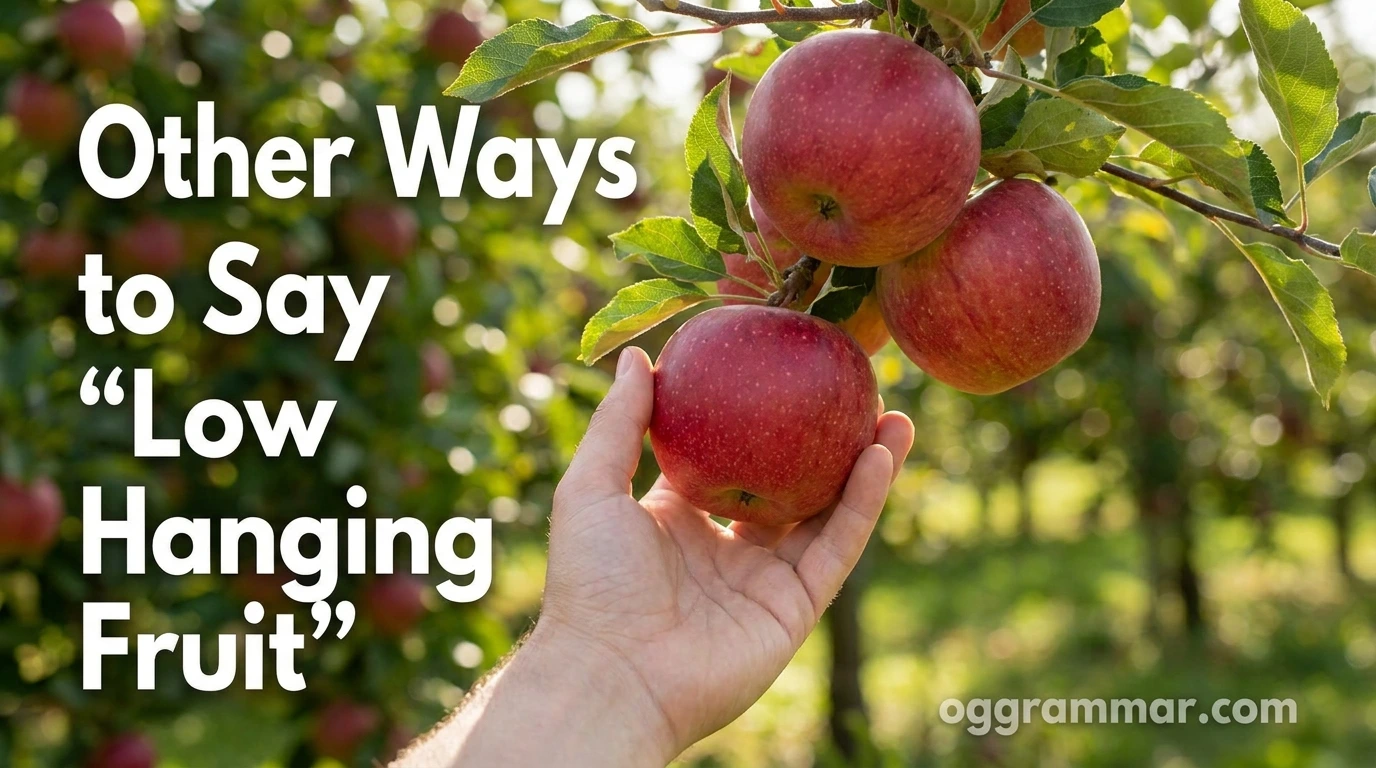
Sometimes the easiest idea is also the one that sounds the most overused.
“Low hanging fruit” is a phrase people reach for when they want to describe the simplest, quickest, or most obvious opportunity. It works well in meetings, strategy sessions, performance reviews, and casual business conversations. But after hearing it again and again, many people start looking for better ways to say it.
That search makes sense. Strong communication is not only about sounding polished; it is about sounding precise. An articulate speaker knows that different words create different impressions. An expressive communicator understands that “easy win,” “quick win,” and “straightforward opportunity” do not mean exactly the same thing, even if they overlap. The right choice can make you sound more strategic, more thoughtful, and more professional.
If you are someone who values eloquent writing, verbal intelligence, storytelling skills, and communication mastery, then replacing clichés with sharper language is a small change that can make a big difference. The same is true in public speaking, leadership, marketing, project management, and everyday conversation. The way you describe an easy opportunity can make your message sound practical, persuasive, and memorable.
In this guide, you will find the best alternatives to “low hanging fruit,” along with meanings, tone notes, best-use cases, example sentences, emotional and professional impact, and real-world usage. You will also see how to choose the right phrase based on context, what to avoid in professional settings, and how influential language affects perception.
What Does “Low Hanging Fruit” Mean?
The phrase “low hanging fruit” refers to the easiest, most accessible, least demanding, or most obvious option in a situation.
It often describes:
- quick wins
- simple tasks
- easy opportunities
- obvious targets
- immediate results
- low-effort gains
Example
“Let’s start with the low hanging fruit before moving to the more complex work.”
The phrase is widely used in business, productivity, sales, and planning. However, because it has become so common, many people prefer alternatives that sound fresher, clearer, or more professional.
Why Communication Skills Matter When Replacing Clichés
Being “good with words” is not just about vocabulary size. It is about choosing the phrase that best fits the audience and the moment. A charismatic speaker can describe the same idea in several ways depending on the situation. An expressive communicator knows when to sound strategic, when to sound casual, and when to sound formal.
That is why people search for other ways to say “low hanging fruit.” They want language that sounds:
- more precise
- less cliché
- more polished
- more professional
- more natural
In business communication, the wrong phrase can sound lazy or overly casual. The right phrase can make you sound like someone with strong linguistic ability and real communication mastery.
Did You Know?
People often perceive speakers as more competent when they avoid overused business clichés and use more specific language instead.
Quick Comparison Table of Alternatives
| Alternative Phrase | Tone | Meaning | Best Use Case |
| Quick win | Positive | Easy result with fast payoff | business and project planning |
| Easy win | Casual-professional | Simple success | informal strategy discussions |
| Obvious opportunity | Direct | Clear and visible chance | presentations and analysis |
| Simple solution | Neutral | Straightforward fix | problem-solving |
| Immediate opportunity | Professional | A chance available now | business and sales |
| Low effort task | Practical | Something requiring little work | productivity and planning |
| Straightforward option | Polite | Simple and clear choice | meetings and decisions |
| First step | Encouraging | Initial easy action | coaching and strategy |
| Low-risk gain | Analytical | Benefit with minimal danger | finance and business |
| Accessible target | Formal | A reachable goal | planning and performance |
| Best starting point | Supportive | Good place to begin | leadership and training |
| Easy target | Casual | Something simple to achieve | informal conversation |
| Quick opportunity | Neutral | Chance that can be acted on fast | sales and operations |
| Low complexity task | Professional | Simple task with little difficulty | workplace communication |
| Immediate payoff | Persuasive | Benefit that happens soon | marketing and decision-making |
Best Other Ways to Say “Low Hanging Fruit”
Quick Win
Meaning
A task, opportunity, or action that produces results quickly and easily.
Tone
Positive, modern, and professional.
Best Use Case
Business strategy, productivity discussions, team planning.
Example Sentence
“Fixing the landing page is a quick win that could improve conversions immediately.”
Detailed Explanation
This is one of the strongest alternatives because it sounds modern and action-oriented. It focuses on speed, simplicity, and visible results.
Emotional or Professional Impact
It makes the opportunity sound smart, practical, and worthwhile.
Real-Life Usage Context
Common in marketing, management, and startup culture.
Easy Win
Meaning
A simple success that requires minimal effort.
Tone
Casual-professional.
Best Use Case
Team meetings, project management, informal business conversations.
Example Sentence
“Updating the FAQ section is an easy win for improving customer experience.”
Detailed Explanation
This phrase is slightly more conversational than “quick win,” but still sounds useful and efficient.
Emotional or Professional Impact
Creates optimism and momentum.
Real-Life Usage Context
Used in operations, brainstorming, and productivity discussions.
Obvious Opportunity
Meaning
A chance that is easy to see and likely worth pursuing.
Tone
Direct and strategic.
Best Use Case
Business analysis, presentations, planning sessions.
Example Sentence
“Improving our email subject lines is an obvious opportunity for better engagement.”
Detailed Explanation
This phrase works when you want to sound thoughtful and analytical instead of casual.
Emotional or Professional Impact
Signals clarity and business awareness.
Real-Life Usage Context
Common in consulting, strategy, and leadership discussions.
Simple Solution
Meaning
A straightforward way to solve a problem.
Tone
Neutral and practical.
Best Use Case
Problem-solving, training, technical communication.
Example Sentence
“Switching to a shorter workflow created a simple solution for the team.”
Detailed Explanation
This phrase emphasizes clarity and efficiency rather than opportunity alone.
Emotional or Professional Impact
Makes the speaker sound calm, rational, and helpful.
Real-Life Usage Context
Used in operations, support, and management communication.
Immediate Opportunity
Meaning
A chance that is available right now and can be acted on quickly.
Tone
Professional and decisive.
Best Use Case
Sales, business development, leadership communication.
Example Sentence
“Expanding into that market presents an immediate opportunity for growth.”
Detailed Explanation
This phrase is especially useful when the benefit is time-sensitive.
Emotional or Professional Impact
Creates urgency and strategic focus.
Real-Life Usage Context
Common in business reports, sales pitches, and executive communication.
Low Effort Task
Meaning
A task that does not require much energy or time.
Tone
Practical and neutral.
Best Use Case
Productivity planning, task prioritization.
Example Sentence
“Responding to those customer emails is a low effort task we can finish today.”
Detailed Explanation
This phrase is more functional than flashy. It works well in practical discussions.
Emotional or Professional Impact
Makes planning feel organized and efficient.
Real-Life Usage Context
Used in workflow management and team coordination.
Straightforward Option
Meaning
A choice that is simple, clear, and easy to act on.
Tone
Polite and professional.
Best Use Case
Decision-making, meetings, and collaborative planning.
Example Sentence
“Taking the direct route is the most straightforward option for this project.”
Detailed Explanation
This phrase sounds respectful and thoughtful, especially when discussing choices with others.
Emotional or Professional Impact
Creates a calm and logical impression.
Real-Life Usage Context
Common in business meetings and consulting conversations.
First Step
Meaning
The initial action that starts a process.
Tone
Encouraging and positive.
Best Use Case
Coaching, leadership, training, personal development.
Example Sentence
“Writing the outline is the first step toward finishing the report.”
Detailed Explanation
This phrase is great when you want to sound motivating instead of overly transactional.
Emotional or Professional Impact
Makes action feel manageable and forward-looking.
Real-Life Usage Context
Used in mentoring, leadership, and educational settings.
Low-Risk Gain
Meaning
A benefit that can be achieved without much danger or downside.
Tone
Analytical and business-like.
Best Use Case
Finance, strategy, operations, investment discussions.
Example Sentence
“Automating invoice reminders is a low-risk gain that could save time every month.”
Detailed Explanation
This phrase sounds more technical and careful than “low hanging fruit,” which makes it useful in data-driven environments.
Emotional or Professional Impact
Creates a sense of strategic caution and smart decision-making.
Real-Life Usage Context
Used in finance, operations, and executive planning.
Best Starting Point
Meaning
The most practical place to begin.
Tone
Supportive and constructive.
Best Use Case
Training, coaching, planning, leadership.
Example Sentence
“Cleaning up the homepage is the best starting point for improving user experience.”
Detailed Explanation
This phrase is especially useful when guiding a team or helping someone prioritize.
Emotional or Professional Impact
Feels helpful and collaborative.
Real-Life Usage Context
Used in workshops, mentorship, and strategic discussions.
Immediate Payoff
Meaning
A benefit that comes quickly and clearly.
Tone
Persuasive and results-oriented.
Best Use Case
Marketing, sales, management, and decision-making.
Example Sentence
“Improving the checkout process offers immediate payoff for customer satisfaction.”
Detailed Explanation
This phrase highlights value and fast results, making it powerful in persuasive language.
Emotional or Professional Impact
Creates excitement and urgency.
Real-Life Usage Context
Common in growth strategy and business communication.
Formal vs Casual Alternatives
Formal Alternatives
These work best when you want to sound:
- strategic
- polished
- analytical
- professional
Examples:
- Immediate opportunity
- Low-risk gain
- Straightforward option
- Obvious opportunity
Casual Alternatives
These work best when you want to sound:
- friendly
- natural
- conversational
- modern
Examples:
- Quick win
- Easy win
- First step
- Best starting point
Why Tone Matters
An articulate speaker understands that the same idea can sound either mechanical or insightful depending on tone. Communication mastery is about choosing words that fit the room, the relationship, and the goal.
How to Choose the Right Alternative
The best synonym depends on:
- Audience
- Industry
- Context
- Desired emotional effect
- Level of formality
For Business Strategy
Use:
- Quick win
- Immediate opportunity
- Low-risk gain
- Obvious opportunity
For Team Planning
Use:
- Easy win
- Best starting point
- First step
- Straightforward option
For Analytical or Executive Writing
Use:
- Low-risk gain
- Immediate opportunity
- Low complexity task
- Strategic opportunity
For Casual Conversation
Use:
- Quick win
- Easy win
- First step
Mini Communication Tip
An expressive communicator does not choose the fanciest phrase. They choose the phrase that sounds accurate and natural in context.
Common Mistakes When Using “Low Hanging Fruit”
Overusing the Phrase
Repeating it too often can make you sound cliché or unoriginal.
Using It Without Specificity
If you say something is “low hanging fruit” without explaining why, the listener may not know what you mean.
Sounding Too Casual in Formal Settings
A phrase that works well in a startup meeting may not suit an executive report.
Ignoring the Difference Between Easy and Valuable
Not all easy tasks are worthwhile, and not all worthwhile tasks are easy.
Words to Avoid in Professional Settings
Avoid expressions like:
- “Easy peasy”
- “No-brainer” in sensitive settings
- “Piece of cake” in formal reports
- “Super simple” in serious business communication
- “Grab the low-hanging fruit” in highly polished writing
These can sound too casual or overly colloquial depending on the setting.
Better Professional Choices
- Quick win
- Immediate opportunity
- Simple solution
- Straightforward option
The Psychology Behind Influential Language
Words change how people evaluate ideas.
A phrase like “quick win” sounds active and promising. A phrase like “low-risk gain” sounds careful and strategic, A phrase like “first step” sounds approachable and motivating.
An expressive communicator understands that wording affects:
- confidence
- clarity
- urgency
- motivation
- trust
That is why persuasive language matters in leadership, public speaking, and everyday decision-making.
Expert Insight
People are often more willing to support an idea when it sounds easy to implement and likely to succeed. That is one reason “quick win” is so effective in business communication.
Practical Tips to Improve Verbal Communication Skills
Be Specific
Instead of saying something is easy, explain why it is easy and why it matters.
Match Tone to Audience
Use formal language in executive settings and conversational language in casual discussions.
Replace Clichés Thoughtfully
Look for alternatives that are more precise than the original phrase.
Practice Rewriting Common Business Phrases
Try turning “low hanging fruit” into multiple versions:
- a quick win
- a straightforward option
- an immediate opportunity
- a low-risk gain
Listen to Charismatic Speakers
Strong communicators often use simple language that feels intentional, not overworked.
Scenario-Based Examples
Marketing Meeting
Instead of: “We should focus on the low hanging fruit first.”
Try: “We should focus on the quick wins first to build momentum.”
Why it works: It sounds clear and strategic.
Executive Presentation
Instead of: “That report is low hanging fruit.”
Try: “That report represents an immediate opportunity for operational improvement.”
Why it works: It sounds polished and professional.
Team Chat
Instead of: “Let’s grab the low hanging fruit.”
Try: “Let’s start with the easiest win and build from there.”
Why it works: It feels conversational and motivating.
Coaching Conversation
Instead of: “Take the low hanging fruit.”
Try: “Start with the best starting point and work upward.”
Why it works: It sounds supportive and encouraging.
Did You Know?
Many business phrases become clichés because they are easy shorthand for complex ideas. But strong writers and speakers often replace clichés with more precise terms to sound clearer, smarter, and more intentional.
Practical Phrases Readers Can Use Immediately
Professional
- Quick win
- Immediate opportunity
- Low-risk gain
- Straightforward option
Casual
- Easy win
- First step
- Best starting point
- Simple solution
Strategic
- Obvious opportunity
- Low complexity task
- Immediate payoff
- Accessible target
Motivational
- First step
- Best starting point
- Easy win
- Quick opportunity
FAQs About Other Ways to Say “Low Hanging Fruit”
What is a professional way to say “low hanging fruit”?
Professional alternatives include:
- Quick win
- Immediate opportunity
- Low-risk gain
- Straightforward option
What is a casual alternative?
Casual alternatives include:
- Easy win
- First step
- Best starting point
- Simple solution
Is “low hanging fruit” considered cliché?
Yes, in many business settings it is seen as overused, which is why alternatives can sound fresher.
What phrase is best for strategy meetings?
“Quick win” and “immediate opportunity” work especially well in strategy discussions.
What should I use instead of “low hanging fruit” in writing?
Try:
- quick win
- obvious opportunity
- straightforward option
- low-risk gain
Why do people search for alternatives?
They want to sound clearer, more polished, and less repetitive.
Is “easy win” professional?
It can be, especially in modern workplaces and collaborative settings.
What is the most analytical alternative?
“Low-risk gain” sounds especially analytical and business-oriented.
How can I sound more articulate at work?
Use precise wording, avoid clichés, and choose the phrase that fits the audience and context.
Why does vocabulary variety matter?
It improves clarity, persuasion, professionalism, and communication mastery.
Conclusion
Learning other ways to say “low hanging fruit” is a simple but powerful way to improve your communication. Whether you choose quick win, easy win, straightforward option, immediate opportunity, or low-risk gain, the right phrase can make your ideas sound sharper, more professional, and more persuasive.
An articulate speaker knows that even a familiar business phrase can be replaced with wording that feels more precise and intentional. An expressive communicator understands that tone matters just as much as meaning. And someone with strong linguistic ability knows how to match language to the audience, the situation, and the outcome they want to create.
The best communication is not just clear. It is thoughtful. By expanding your vocabulary and using alternatives with care, you can sound more confident, more strategic, and more memorable in every conversation.
